What is inside HoneyFil
The label prints eight entries, and there is nothing beyond them. They sort into three groups of two, two and four, arriving at eight because each entry occupies a line of its own instead of being gathered beneath a heading.
Nowhere on the bottle is there a proprietary blend. Naming a handful of ingredients without disclosing how they divide is what a blend line usually accomplishes, and this label does without one. All eight appear under their own names, and the Supplement Facts panel on the bottle you receive states the amount of each.
What follows restates the panel and sets out what each entry is. These are descriptions of ingredients rather than claims about what a serving of HoneyFil will do.
Vitamin B3 (Niacin)
Essential nutrient · Carries a recognised daily value
Water soluble, so nothing accumulates. Whatever a day spends, the next day's serving has to supply again.
Niacin is converted before it becomes useful. What the body builds from it is a pair of coenzymes, and once they exist practically every reaction that releases energy from a meal passes through one or the other. Nothing meaningful is stored, so the panel value is replenishing yesterday rather than adding to a balance.
Zinc (as Zinc Oxide)
Essential mineral · Carries a recognised daily value
Hundreds of enzymes are assembled around it and the body warehouses none of it. That pairing is why it recurs on men's panels.
The breadth is what stands out. Zinc sits inside the structure of several hundred different enzymes, and the body maintains no store of consequence, meaning today has to supply whatever yesterday used. Broad demand with nothing held back is the reason it appears on almost every men's panel in print.
L-Citrulline
Amino acid · Amino acid, listed on its own
It earns its place on the panel for what it becomes downstream rather than for anything it does on arrival.
The compound that relaxes a vessel wall is arginine, and arginine taken directly is mostly dismantled on its first pass through the liver. L-citrulline is not dismantled there. It comes through whole and converts afterwards, which is why the longer route turns out to be the surer one.
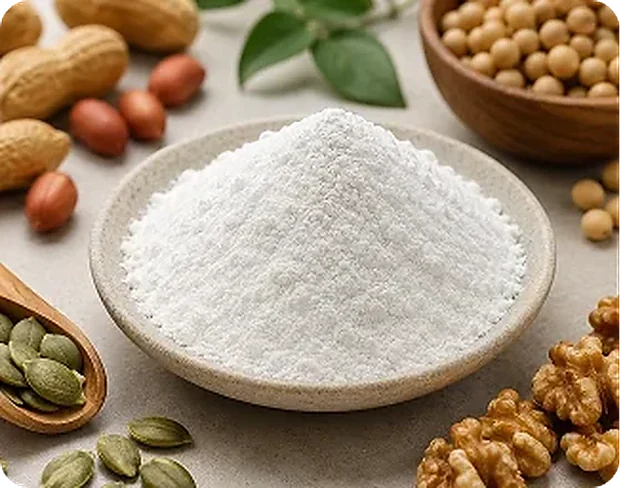
L-Carnitine
Amino acid compound · Amino acid compound, listed on its own
Without it, long-chain fat sitting inside a cell never reaches the compartment that burns it. Transport, not fuel.
A cell can hold fatty acids it has no access to, because the inner mitochondrial membrane will not let them pass unaided. L-carnitine is what carries them over. It contributes no energy of its own; what it determines is whether stored fat ever reaches the machinery that could burn it.
Pine Bark Extract
Botanical extract · Botanical extract, standardised
Drawn from maritime pine on the French Atlantic seaboard and standardised, so one batch can be set against another.
The extract is taken from maritime pine grown in plantations along the Atlantic coast of south-west France, and it is standardised on proanthocyanidin content. That standardisation is the substantive part: it lets a supplier demonstrate that this batch carries the same marker level as the last.
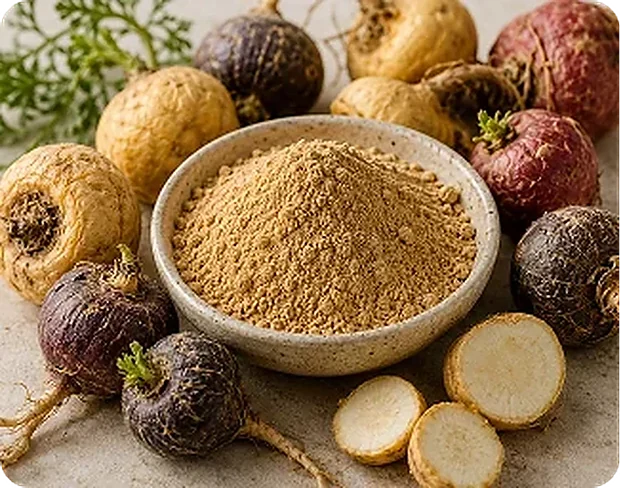
Maca Root Extract
Botanical extract · Botanical extract, standardised
A high-altitude Andean root crop, eaten as ordinary food on the plateau for generations before anyone concentrated it.
The crop grows high on the Peruvian altiplano, where frost belongs to the normal calendar and the growing season is counted in weeks rather than months. It was food there for generations before anyone concentrated it, and describing it that way is more accurate than presenting it as a find.
Grape Skin Extract
Botanical extract · Botanical extract, standardised
Taken from the skin, which is where a grape keeps its polyphenols, rather than from the juice.
Press a grape and the juice goes one way while the skin goes the other, and the polyphenols overwhelmingly follow the skin. The extract concentrates that fraction, so what appears on the panel derives from the part a winery has no use for.
Saffron Stigmas Extract
Botanical extract · Botanical extract, standardised
Hand-picked stigmas, three to a flower. Nothing else on this label comes close to its cost per gram.
Three crimson stigmas grow in each crocus flower, and every one is removed by hand on the morning the flower opens. All of saffron's cost traces back to that labour, and gram for gram it is dearer than anything else this label names.
Further reading behind the HoneyFil formula
- Niacin — NIH Office of Dietary Supplements
- Zinc — NIH Office of Dietary Supplements
- Maca — NIH NCCIH herb summary
These are public reference pages on three of the ingredients. Not one of them concerns HoneyFil, and not one is an endorsement of it.